Future-Proofing UK Homes: Deploying Cat8 Ethernet for 40GbE Residential Networks
As a UK-certified installer, Gary Pearce, I've witnessed the dramatic evolution of residential data demands over the past two decades. What was once a luxury is now a fundamental utility, and the pace of this evolution shows no signs of slowing. We are at a critical juncture where the commonly installed Category 5e (Cat5e) and Category 6 (Cat6) cabling, while still functional for many applications, are rapidly becoming bottlenecks for the true potential of modern home technology. The time has come to seriously consider and deploy Category 8 (Cat8) Ethernet cabling to enable 40 Gigabit Ethernet (40GbE) residential networks, effectively future-proofing UK homes for decades to come.
This isn't merely about incremental upgrades; it's about a foundational shift in how we conceive and construct our home network infrastructure. With the relentless proliferation of bandwidth-hungry devices, high-resolution media, cloud-based services, and emerging technologies, 40GbE capability is no longer an extravagant luxury but an impending necessity.
The Bandwidth Imperative: Why 40GbE is Becoming Essential
Consider the digital landscape of the contemporary UK home. A typical household may simultaneously be:
- Streaming multiple 4K or even 8K video feeds.
- Engaging in low-latency cloud gaming or virtual reality (VR) experiences.
- Utilising bandwidth-intensive professional applications for remote work (e.g., CAD, video editing, large dataset analysis).
- Backing up terabytes of data to a Network Attached Storage (NAS) or cloud service.
- Managing a sophisticated smart home ecosystem with numerous Internet of Things (IoT) devices, IP cameras, and advanced automation.
- Hosting guests who bring their own array of connected devices.
Current residential networks, often built upon Cat5e or Cat6, typically offer 1 Gigabit Ethernet (1GbE) or, at best, 10 Gigabit Ethernet (10GbE) over shorter distances with Cat6A. While 1GbE might suffice for a single 4K stream, it quickly becomes saturated under the combined load of the scenarios outlined above. Even 10GbE, while a significant leap, can prove insufficient for multi-user, multi-application environments, especially as higher resolutions, more immersive VR, and instantaneous cloud interactions become standard.
40GbE offers a four-fold increase over 10GbE, providing immense headroom. This isn't just about raw speed; it's about significantly reduced latency, enhanced responsiveness for all connected devices, and the capacity to seamlessly integrate future technologies without encountering infrastructure limitations. This superior capacity is critical for applications that demand both high throughput and low latency, ensuring a smooth and uninterrupted user experience across the entire digital home.
Understanding Ethernet Standards: From Cat5e to Cat8
To appreciate the significance of Cat8, it's crucial to understand the progression of Ethernet cabling standards. Each category represents an improvement in bandwidth, frequency, and signal integrity, allowing for higher data rates over specified distances.
#### A Technical Comparison of Ethernet Cabling Categories
| Standard | Max Bandwidth (Per Pair) | Max Frequency (MHz) | Max Distance for Max Speed | Shielding (Common) | Typical Use Case |
|---|---|---|---|---|---|
| Cat5e | 1 Gbps | 100 | 100 metres | UTP | Basic Home/Office 1GbE |
| Cat6 | 1 Gbps (10GbE over 37-55m) | 250 | 100 metres (1GbE) | UTP | Enhanced Home/Office 1GbE, short 10GbE |
| Cat6A | 10 Gbps | 500 | 100 metres | UTP, F/UTP, S/FTP | Data Centres, Enterprise 10GbE |
| Cat8 | 40 Gbps | 2000 | 30 metres | S/FTP, F/UTP | Data Centres, High-Performance Residential 25/40GbE |
#### Deep Dive into Category 8 (Cat8)
Cat8 is a revolutionary leap in twisted-pair copper cabling, specifically engineered to support 25 Gigabit Ethernet (25GBASE-T) and 40 Gigabit Ethernet (40GBASE-T) applications. It is defined by the IEEE 802.3bq standard.
Key technical specifications and characteristics of Cat8:
1. Frequency Range: Cat8 cables are designed to support frequencies up to 2000 MHz, a significant increase from Cat6A's 500 MHz. This expanded frequency range is fundamental to achieving higher data rates.
2. Maximum Distance: While Cat8 can deliver 25GbE/40GbE, its maximum channel length is limited to 30 metres (including up to 2 connectors) when maintaining full 40GbE performance. This characteristic makes it ideally suited for server room interconnects and, crucially, for residential applications where runs within a single property rarely exceed this length.
3. Shielding Requirements: Unlike Cat5e/Cat6/Cat6A which commonly utilise Unshielded Twisted Pair (UTP) designs, Cat8 requires shielding to achieve its performance targets and mitigate alien crosstalk at such high frequencies. There are two primary types:
- Cat8.1: Specified to operate with RJ45 connectors (IEC 60603-7-81 compliant). It typically uses F/UTP (Foiled/Unshielded Twisted Pair) or S/FTP (Shielded/Foiled Twisted Pair) construction. The shielding is crucial for rejecting external electromagnetic interference (EMI) and preventing alien crosstalk.
- Cat8.2: Specified to operate with TERA or GG45 connectors (IEC 60603-7-82 compliant), which are less common in residential installations. It exclusively uses S/FTP cabling. For residential installations in the UK, Cat8.1 with its RJ45 compatibility is the pragmatic and preferred choice.
- Near-End Crosstalk (NEXT): The interference from a transmitting pair to a receiving pair in the same cable at the near end.
- Far-End Crosstalk (FEXT): The interference measured at the far end.
- Return Loss: A measure of reflections in the cable due to impedance mismatches.
- Insertion Loss: Signal attenuation over the length of the cable.
- Alien Crosstalk (AXT): Critical for Cat8, this measures interference between adjacent cables. At 2000 MHz, AXT mitigation is paramount, which is why robust shielding is mandated.
4. Performance Parameters: To meet 25GBASE-T and 40GBASE-T requirements, Cat8 cabling must demonstrate superior performance across a range of parameters, including:
It's important to note that Cat8 is fully backward compatible with lower categories (Cat5e, Cat6, Cat6A), meaning you can connect Cat8 to a Cat6A switch or device, and it will operate at the highest common speed. This ensures a seamless upgrade path.
Architecting a 40GbE Residential Network with Cat8
Designing a 40GbE network within a home environment requires careful planning and the selection of compatible components. As a UK-certified installer, I advocate for a structured cabling approach, which provides flexibility, manageability, and scalability.
#### Core Components for a Cat8 40GbE Network
1. Cat8 Cabling: Opt for high-quality S/FTP (Shielded Foiled Twisted Pair) Cat8.1 cable. The individual pair shielding and overall braid shield offer superior protection against EMI and AXT, which are critical for 40GbE performance. Ensure the cable is CPR (Construction Products Regulation) compliant for fixed installations in the UK, typically requiring Euroclass Cca or B2ca for fire safety.
2. Cat8 Keystone Jacks/Modules: These are the termination points within wall outlets. They must be Cat8 compliant and designed to maintain the cable's shielding integrity through to the connection. Tool-less designs can simplify termination but require precision.
3. Cat8 Patch Panels (for structured wiring cabinet): For a centralised networking hub, a Cat8 compliant shielded patch panel allows for clean, organised termination of all horizontal runs from wall outlets. This provides a flexible patching field to connect to active network equipment.
4. Cat8 Patch Cables: Use factory-tested, shielded Cat8 patch cables (typically 2m or less) to connect active equipment to patch panels, and client devices to wall outlets. Never compromise on patch cable quality; they are an integral part of the overall channel performance.
5. 40GbE Switches: This is where the budget often becomes a consideration. Dedicated 40GbE switches are currently more prevalent in data centres. However, for residential use, multi-gigabit switches (supporting 2.5GbE, 5GbE, 10GbE) are becoming more common and affordable. Look for switches with SFP+ (10GbE) or SFP28 (25GbE) ports which, with appropriate transceivers, can form the backbone. As 40GbE copper interfaces become more mainstream for home use, dedicated RJ45 40GbE switches will emerge. Currently, many "40GbE" solutions for short copper runs use QSFP+ ports which require specific breakout cables to RJ45, or DACs (Direct Attach Cables). For an RJ45 based solution, you might start with 10GbE switches capable of multi-gig or consider SFP+/SFP28 for your backbone and convert at endpoints.
6. Network Interface Cards (NICs): Client devices (high-end PCs, servers, NAS units) will require 40GbE (or 25GbE) capable NICs. These are typically PCIe cards with SFP28 or QSFP+ ports. Ensure driver compatibility with your operating system.
#### Network Topology Considerations
A star topology with a central structured wiring cabinet remains the gold standard for residential networks. All Cat8 cable runs should originate from this central point and terminate at individual wall outlets throughout the home.
- Structured Wiring Cabinet: This should be centrally located, well-ventilated, accessible, and equipped with adequate power outlets. It houses the patch panel, switch, router, and potentially a NAS or home server. Proper earthing/grounding for the shielded cabling system is critical and must be professionally installed.
- Redundancy and Scalability: When pulling cables, consider running two Cat8 cables to critical locations (e.g., main office, media room). This provides immediate redundancy or allows for dual connections to a powerful workstation/server without re-cabling.
- Power over Ethernet (PoE): While Cat8 focuses on data, ensure your switch or a separate PoE injector can provide sufficient power for future PoE-powered devices like Wi-Fi 7 access points, IP cameras, VoIP phones, and smart lighting controllers, leveraging the Cat8 infrastructure for both data and power. Cat8 supports all PoE standards, including PoE++ (Type 4, 90W).
Installation Best Practices for Cat8 (The Installer's Perspective)
As a UK-certified installer, I cannot stress enough that Cat8's performance is highly dependent on meticulous installation. Sloppy workmanship will negate the benefits of premium cabling.
#### Pre-Installation Checklist:
- Cable Selection: Verify Cat8.1 S/FTP, CPR compliance (e.g., Cca, B2ca), and ensure it meets TIA-568.2-D or ISO/IEC 11801 Class I standards.
- Pathway Planning: Design cable routes that minimise tight bends and long unsupported runs. Utilise conduit where possible for protection and future upgrades. Ensure compliance with UK building regulations for fire stopping where cables penetrate fire-rated barriers.
- Equipment Compatibility: Ensure all components (cables, jacks, patch panels, patch cords) are Cat8-rated and from reputable manufacturers to guarantee interoperability and performance.
- Tools: Invest in high-quality crimping tools, punch-down tools (if not tool-less jacks), cable strippers, and a professional cable certifier (e.g., Fluke DSX-8000).
#### Cable Handling:
1. Bend Radius: This is CRITICAL for Cat8. The minimum bend radius for Cat8 S/FTP cable is typically 8 times the cable's overall diameter during installation, and 4 times once installed. Exceeding this will deform the twisted pairs, compromise shielding, and degrade performance.
2. Pulling Tension: Avoid excessive pulling tension. Use cable lubricant where appropriate and ensure cables are not kinked or twisted during installation. The maximum pulling tension for 4-pair copper cable is generally 110 Newtons (25 lbf).
3. Separation from Power Cables: Maintain adequate separation from power cables to prevent EMI. While Cat8's robust shielding significantly helps, best practice dictates a minimum separation of 150-300mm. If unavoidable, crossing at 90-degree angles is preferable.
4. Grounding and Bonding: For a shielded Cat8 system, proper grounding and bonding are not optional. The shields of the cables, patch panels, and wall outlets must be continuously connected to a common, low-impedance earth ground. This typically involves connecting the patch panel to the main earthing terminal (MET) of the building via a suitable earth conductor, and ensuring shielded outlets are correctly installed. Failure to do so can turn the shielding into an antenna, introducing noise rather than rejecting it.
#### Termination:
1. Precision Termination: Whether using punch-down or tool-less jacks, precision is key. Maintain the twist of the pairs as close as possible to the point of termination. The maximum untwisted length for Cat8 is typically 13mm (0.5 inches). Excessive untwisting introduces impedance mismatches and crosstalk.
2. Shield Integrity: Ensure the cable's shield is properly terminated to the jack's metal housing. This continuity is vital for the entire shielded system's performance. Trim excess foil cleanly.
3. Wiring Standard: Consistently use either T568A or T568B wiring standard throughout the installation. T568B is more common in the UK and Europe.
#### Testing and Certification:
A professional Cat8 installation is incomplete without rigorous testing and certification. This is where a UK-certified installer truly demonstrates their value.
1. Certification Equipment: A dedicated cable certifier like the Fluke DSX-8000 CableAnalyzer is essential. It performs comprehensive tests up to 2000 MHz.
2. Testing Standards: Cables must be tested for compliance with TIA-568.2-D Category 8 (Permanent Link or Channel Link) or ISO/IEC 11801 Class I standards.
3. Key Parameters Tested:
- Wire Map: Checks for miswires, opens, shorts, and split pairs.
- Length: Verifies the cable is within the 30-metre limit for 40GbE.
- Near-End Crosstalk (NEXT) and Power Sum NEXT (PSNEXT): Measures interference between pairs.
- Far-End Crosstalk (FEXT) and Power Sum Attenuation-to-Crosstalk Ratio Far-End (PSACR-F): Measures interference at the far end.
- Return Loss: Checks for signal reflections.
- Insertion Loss (Attenuation): Measures signal loss over distance.
- Alien Crosstalk (AXT): Crucially, the certifier will measure AXT between bundled cables to ensure external interference is minimal.
4. Documentation: Detailed test reports for each certified link should be provided, guaranteeing the performance of the installed infrastructure. This documentation is invaluable for troubleshooting and for providing evidence of a high-quality installation, should the property be sold.
Cost vs. Benefit Analysis
The initial investment in Cat8 cabling and associated hardware will undoubtedly be higher than a Cat6A installation. Cat8 cable itself, along with the jacks, patch panels, and particularly 40GbE active equipment, carries a premium. However, this must be weighed against the long-term benefits:
- Longevity: A Cat8 40GbE network, properly installed, will likely remain relevant and high-performing for well over two decades, accommodating unforeseen technological advancements. This avoids the disruptive and costly process of re-cabling in the future.
- Property Value: A professionally installed, certified 40GbE network is a significant enhancement to any property, particularly in an increasingly digital world. It can be a strong selling point, akin to advanced smart home systems.
- Uninterrupted Performance: Eliminating network bottlenecks ensures a superior user experience for all applications, from entertainment to critical work tasks.
- Energy Efficiency: While higher speeds consume more power at the switch level, efficient 40GbE hardware is often designed to scale power consumption, and the ability to handle more data with fewer devices or less time can contribute to overall efficiency.
The Future is Now: Real-World Applications
Beyond the core technical aspects, consider the practical implications of a 40GbE residential network:
- Multi-8K/16K Streaming: Flawless delivery of ultra-high-definition content to multiple screens simultaneously, including future holographic displays.
- Low-Latency Cloud Gaming/VR: A truly immersive and responsive experience, indistinguishable from local processing.
- Local High-Speed NAS/Server Access: Instantaneous access to vast personal media libraries, professional project files, and rapid backups, removing the last vestiges of network delay.
- Professional Home Offices: Empowering professionals with the same network performance they would expect in a high-end corporate data centre, facilitating seamless collaboration and massive data transfers.
- High-Density Wi-Fi 7 Backhaul: Future Wi-Fi 7 (802.11be) Access Points will require multi-gigabit backhaul connections. A 40GbE backbone ensures your wired infrastructure won't be the bottleneck for your wireless network.
- AI/Machine Learning at Home: Running powerful local AI models or processing large datasets for personal or professional projects will become increasingly feasible.
Conclusion
The decision to deploy Cat8 Ethernet for a 40GbE residential network in the UK is a strategic investment in the digital future of your home. It moves beyond merely addressing current bandwidth needs to proactively establishing a resilient, high-performance infrastructure capable of supporting the next generation of digital living.
As a UK-certified installer, I advocate for this approach not as an extravagant upgrade, but as a pragmatic necessity for discerning homeowners who demand uncompromising performance and long-term value. The complexities of Cat8 installation, particularly regarding shielding, grounding, and termination precision, necessitate engaging with qualified professionals. A professionally designed and installed Cat8 network guarantees certified performance, delivering the full promise of 40GbE and securing your home's digital readiness for decades.
For expert consultation on designing and installing a future-proof Cat8 network in your UK home, please refer to our online contact page to discuss your project requirements.
---
Frequently Asked Questions (FAQ)
Q1: Is Cat8 really necessary for a typical UK home today, or is Cat6A sufficient?
A1: While Cat6A can provide 10GbE over 100 metres and is a significant improvement over Cat5e/Cat6, it supports a maximum frequency of 500 MHz. Cat8, designed for 2000 MHz, is specifically engineered for 25GbE and 40GbE over shorter distances (up to 30 metres). For a "typical" home today, Cat6A might seem sufficient. However, considering the rapid growth of bandwidth-intensive applications like multi-8K streaming, cloud gaming, professional remote work, and the impending widespread adoption of Wi-Fi 7 (which demands multi-gigabit wired backhaul), Cat6A may quickly become a bottleneck for future requirements. Deploying Cat8 now is about future-proofing, ensuring your wired infrastructure can handle technologies not yet fully conceived without needing costly re-cabling in 5-10 years. It's a strategic long-term investment for those who demand the highest performance and longevity from their home network.
Q2: What is the main difference in installation for Cat8 compared to Cat6A, and why is professional installation so crucial?
A2: The primary difference lies in the stringent requirements for maintaining signal integrity at much higher frequencies (2000 MHz vs. 500 MHz). Cat8 requires shielding (S/FTP or F/UTP) to combat alien crosstalk and EMI, which means proper grounding and bonding of the entire system are absolutely critical. Installation demands exceptionally precise termination, minimal untwisting of pairs, and strict adherence to bend radius limits. Any compromise in these areas will severely degrade performance, potentially making a 40GbE link perform no better than a 10GbE or even 1GbE link. Professional installers are equipped with specialised tools, certified training, and experience in handling shielded cabling systems, ensuring continuity of shielding, correct earthing, and precise termination to meet Cat8 certification standards. This level of precision is difficult to achieve without expert knowledge and equipment.
Q3: Can I mix Cat8 cables with my existing Cat6A or Cat5e infrastructure?
A3: Yes, Cat8 cabling is fully backward compatible with lower category standards (Cat5e, Cat6, Cat6A). You can connect a Cat8 cable to a Cat6A wall outlet, a Cat6A patch panel, or a Cat5e device. The network will simply operate at the highest common speed supported by the weakest link in the chain. For example, if you connect a Cat8 cable from a 40GbE device to a Cat6A port on a switch, the connection will negotiate down to 10GbE. This backward compatibility ensures a seamless upgrade path, allowing you to gradually introduce Cat8 infrastructure to critical areas while leveraging existing cabling for less demanding applications.
Q4: What specific devices in a home would truly benefit from a 40GbE connection over Cat8?
A4: While all devices will benefit from a more robust and lower-latency network, specific devices that see the most significant advantage include:
1. High-Performance Workstations/Gaming PCs: For large file transfers (e.g., video editing, CAD projects), low-latency cloud gaming, or intensive data processing.
2. Network Attached Storage (NAS) Servers: Essential for rapid backups, streaming multiple high-bitrate media files simultaneously, and serving as a central data repository for multiple users.
3. Home Servers/Media Servers: For hosting virtual machines, running local AI/ML models, or serving a vast media library.
4. Wireless Access Points (APs): Especially future Wi-Fi 7 (802.11be) APs, which can aggregate multiple gigabit connections wirelessly, requiring a multi-gigabit or 40GbE wired backhaul to the network switch to prevent bottlenecks.
5. High-End Smart Home Controllers/Gateways: Those that process large amounts of data from numerous IoT devices or high-resolution IP cameras.
6. Video Editing Suites: Facilitating rapid access to footage stored on local servers or NAS, dramatically reducing project times.
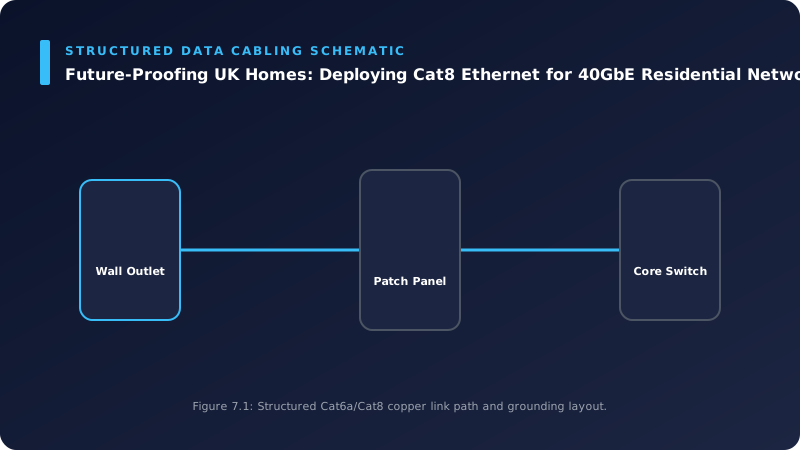
📊 Technical System Design Reference Infographic
Related Technical Resource: Network Latency Reduction: A Technical Approach to PING Optimisation for UK Online Gaming
Technical Standards and Industry Resources
- External Compliance Guidance: Industry Standards & Compliance Resources
- Partner Site Feed: Gary Pearce Portfolio Services - Strikingly Site


Comments