Forensic Video Retrieval: Best Practices for Evidential Chain of Custody in UK CCTV

As Gary Pearce, a UK-certified installer with extensive experience in security and surveillance systems, I've observed firsthand the critical role that CCTV footage plays in criminal investigations, civil disputes, and insurance claims across the United Kingdom. However, the mere existence of footage is insufficient; its forensic integrity and the meticulously documented chain of custody are paramount to its admissibility and weight as evidence in a court of law. This detailed guide explores the best practices for forensic video retrieval, focusing specifically on ensuring an unbroken evidential chain of custody within the unique regulatory landscape of UK CCTV operations.
The Indispensable Role of CCTV in UK Investigations
Modern CCTV systems, from sophisticated IP networks to legacy analogue installations, have become ubiquitous. They provide invaluable visual records that can identify perpetrators, establish timelines, corroborate testimonies, and ultimately contribute to justice. From a minor shoplifting incident to complex homicides, video evidence frequently serves as the bedrock of an investigation. Yet, its power hinges entirely on its provable authenticity and the meticulous procedures followed from the moment of capture to its presentation in court. Any deviation from established forensic protocols can render otherwise conclusive evidence inadmissible, compromising the entire investigative process.
Defining Evidential Chain of Custody
The "evidential chain of custody" refers to the chronological documentation or paper trail, showing the seizure, custody, control, transfer, analysis, and disposition of evidence. In the context of forensic video, it means demonstrating precisely who has had possession of the digital video file, at what time, for what purpose, and under what conditions, from the moment it leaves the recording device until it is presented in legal proceedings.
The primary objectives of maintaining a robust chain of custody are:
1. Preservation of Integrity: To ensure the evidence has not been altered, tampered with, or corrupted.
2. Admissibility: To satisfy legal requirements for the evidence to be accepted by the court.
3. Authenticity: To prove that the evidence is what it purports to be.
4. Accountability: To identify every individual who handled the evidence.
Failure to uphold this chain can lead to challenges regarding the evidence's authenticity, potentially leading to its exclusion, irrespective of its content.
Legal Framework and Guidelines in the UK
Forensic video retrieval in the UK operates within a stringent legal and regulatory framework. Professionals involved in this process must have a comprehensive understanding of these guidelines:
1. Police and Criminal Evidence Act (PACE) 1984: This foundational legislation, along with its Codes of Practice, governs police powers and procedures, including the seizure and retention of evidence. Code B specifically addresses search and seizure. Any evidence seized under PACE must be handled in a manner that protects its integrity.
2. Data Protection Act 2018 (DPA 2018) / General Data Protection Regulation (GDPR): CCTV footage often contains personal data, making it subject to DPA 2018 and GDPR. While law enforcement processing for criminal justice purposes has specific exemptions, the initial retrieval from an organisation's system (e.g., a business owner) must consider data minimisation, lawful basis for processing, and data subject rights. This means only retrieving footage directly relevant to the incident and ensuring its secure handling.
3. National Police Chiefs' Council (NPCC) Digital Evidence Guidelines: Formerly the ACPO (Association of Chief Police Officers) guidelines, these provide a framework for the handling of digital evidence. The core principles remain highly relevant:
- Principle 1: No action taken by law enforcement agencies or their agents should change data held on a computer or storage media which may subsequently be relied upon in court.
- Principle 2: In circumstances where a person finds it necessary to access original data held on a computer or storage media, that person must be competent to do so and be able to give evidence explaining the relevance and the implications of their actions.
- Principle 3: An audit trail or other record of all processes applied to computer-based evidence should be created and preserved. An independent third party should be able to examine those processes and achieve the same result.
- Principle 4: The person in charge of the investigation has overall responsibility for ensuring that the law and these principles are adhered to.
Adherence to these principles is non-negotiable for anyone involved in forensic video retrieval in the UK.
Technical Challenges in Forensic Video Retrieval
Before delving into best practices, it's crucial to acknowledge the technical complexities inherent in retrieving CCTV footage:
- Proprietary Formats and Codecs: Many DVRs/NVRs record footage in non-standard, proprietary formats (e.g., .dav, .exe, .h264 in a non-standard wrapper) that require specific player software provided by the manufacturer. This poses challenges for playback, analysis, and compatibility with forensic tools.
- File System Inconsistencies: CCTV recorders often use embedded operating systems and custom file systems that differ from standard Windows (NTFS), macOS (APFS), or Linux (ext4) systems. Direct disk imaging may be necessary, followed by specialised forensic carving tools.
- Overwriting Mechanisms: Most CCTV systems operate on a cyclical recording basis, overwriting the oldest footage when storage capacity is reached. This necessitates rapid response for retrieval, as critical evidence can be lost permanently.
- Time Synchronisation Issues: Recorder clocks can drift, leading to inaccurate timestamps. This can significantly impact the evidential value of footage, especially when correlating with other evidence. Accurate time verification (e.g., comparing with network time protocol servers or synchronised external clocks) is vital.
- Resolution and Frame Rate Degradation: Footage quality can vary significantly. Low resolution, poor compression, or low frame rates (e.g., 5 frames per second or less) can make identification difficult. Understanding the original recording parameters is essential.
- Network Latency and Bandwidth: When retrieving footage over a network, network performance can impact the speed and reliability of the transfer, potentially introducing errors or delays.
Best Practices for On-Site Forensic Video Retrieval: A Step-by-Step Guide
The following methodology ensures that the evidential chain of custody is maintained from the point of retrieval:
#### Phase 1: Initial Assessment & Documentation
1. Secure the Scene: If applicable, the physical location of the incident and the recording device should be secured to prevent tampering or contamination.
2. Initial Contact and Authority: Establish clear communication with the system owner/custodian. Verify authority to access the system and retrieve data. Document this interaction.
3. System Identification: Accurately identify the make, model, and serial number of the DVR/NVR, associated cameras, and storage media (e.g., hard drive capacity). Photograph the device in situ, including connections.
4. Assess Recording Parameters: Determine recording resolution, frame rate, compression codec, and retention policy. Note any potential time discrepancies.
5. Documentation Kit: Prepare a comprehensive kit including:
- Forensic notebook and pens.
- Chain of Custody forms.
- Evidence bags/containers.
- Camera (for scene and device photography).
- Gloves (to avoid leaving fingerprints/DNA).
- External storage (forensically wiped, write-blocked hard drives/SSDs).
- Write-blockers (hardware preferred for reliability).
- Manufacturer-specific player software (if known/available).
- Necessary cables and power supplies.
#### Phase 2: Methodical Extraction
The method of extraction is critical. The primary goal is to obtain a bit-for-bit copy of the relevant data without altering the original.
Option A: Direct Export (When Feasible and Secure)
This is often the first attempt if the DVR/NVR has a robust, manufacturer-provided export function that generates verifiable copies.
1. Consult Manufacturer Manual: Understand the specific export procedure for the DVR/NVR model.
2. Prepare Destination Media: Use a forensically wiped, write-blocked external storage device (e.g., USB HDD/SSD). Ensure sufficient capacity.
3. Initiate Export: Use the DVR/NVR's built-in export function to select the specific date/time range and cameras relevant to the incident.
- Crucial Step: If the system provides a hashing function (e.g., MD5/SHA-256 calculation for the exported file), utilise it and record the hash value immediately.
- If not, upon completion of the export, immediately disconnect the destination media from the DVR/NVR and connect it to a forensic workstation via a hardware write-blocker.
4. Integrity Verification (Post-Export): Calculate the cryptographic hash (e.g., SHA-256) of the exported file(s) on the forensic workstation. If the DVR provided a hash, compare it. If not, this is your initial integrity baseline. Record this hash on the Chain of Custody form.
5. Documentation: Record the exact export process, selected time ranges, camera numbers, file names, sizes, and hash values. Note any errors or interruptions.
Option B: Physical Disk Imaging (When Direct Export is Not Viable or Integrity is Questionable)
This is the preferred forensic method for ensuring a complete, unaltered copy of the original data when direct export is unreliable, produces proprietary non-forensic files, or if the internal clock is suspected to be tampered with.
1. Power Down Safely: Power down the DVR/NVR according to manufacturer guidelines to minimise data corruption. Disconnect power.
2. Remove Storage Media: Carefully remove the internal hard drive(s). Photograph the drive in situ before removal and note its serial number. Use anti-static precautions.
3. Connect via Write-Blocker: Connect the removed hard drive(s) to a dedicated forensic workstation using a hardware write-blocker. A hardware write-blocker is crucial as it physically prevents any write commands from reaching the source drive, guaranteeing its integrity. Software write-blockers, while available, carry a higher risk of bypass.
4. Create Forensic Image: Use recognised forensic imaging software (e.g., FTK Imager, EnCase, X-Ways Forensics) to create a bit-for-bit copy (e.g., E01, DD format) of the entire drive onto a separate, forensically wiped destination drive.
- Hashing: The imaging software will typically calculate a cryptographic hash (MD5 and/or SHA-1, SHA-256) of the source drive before imaging and again after the imaging process, comparing them to ensure a perfect copy. Record these hash values.
5. Return Drive (if necessary): If the original drive must be returned to the system, reinstall it and power on the DVR/NVR. Confirm it operates as expected.
6. Documentation: Document every step: drive serial numbers, write-blocker used, imaging software, destination drive details, and especially the hash values of the source and forensic image.
#### Phase 3: Post-Retrieval Handling and Analysis
1. Secure Storage: The original storage media (if removed) and the forensic image/exported files must be stored securely in an evidence locker with restricted access. Environmental conditions (temperature, humidity) should be considered.
2. Working Copies: All subsequent analysis and processing MUST be performed on a working copy of the forensic image/exported files, never on the original or the primary forensic image. This ensures that the original evidence remains untainted. Create a working copy, and calculate its hash to verify integrity against the primary forensic image.
3. Format Conversion (If Required): If the footage is in a proprietary format, it may need conversion to a common, open format (e.g., MP4, AVI) for broader accessibility and playback.
- Critical Rule: Use a lossless conversion method if possible. If lossy compression is unavoidable, document the conversion process meticulously, noting the software, settings, and output format. Preserve the proprietary player and original file.
- Always generate a new hash for the converted file and document it, explicitly noting it is a derived file.
4. Enhancement (With Caveats): Any enhancement (e.g., brightness, contrast, stabilisation) should be performed on a further working copy and documented in detail. The original unenhanced footage must always be preserved, and the enhancement process must be fully explainable and reversible. Over-enhancement can introduce artefacts or misinterpretations.
5. Forensic Analysis: Utilise specialised forensic video analysis software to extract relevant frames, measure objects, track movements, and perform other analyses. All findings must be documented.
6. Expert Witness Testimony: If the case proceeds to court, the individual who performed the retrieval and analysis must be prepared to give evidence on their qualifications, the methods used, and the findings, explicitly detailing how the chain of custody was maintained.
Technical Deep Dive: Hashing Algorithms & Integrity
Cryptographic hashing is fundamental to digital forensics. A hash function takes an input (the data file) and produces a fixed-size string of characters (the hash value or digest). Even a single bit change in the input data will result in a completely different hash value.
- MD5 (Message-Digest Algorithm 5): Produces a 128-bit hash. While historically common, MD5 is now considered cryptographically broken due to known collision vulnerabilities (where two different inputs can produce the same hash output). While still useful for basic integrity checks, it should not be solely relied upon for high-security forensic validation.
- SHA-1 (Secure Hash Algorithm 1): Produces a 160-bit hash. Similar to MD5, SHA-1 has also been found to have collision vulnerabilities, making it less suitable for critical forensic integrity verification, although it offers more resistance than MD5.
- SHA-256 (Secure Hash Algorithm 256): Part of the SHA-2 family, it produces a 256-bit hash. SHA-256 is currently considered cryptographically secure and is the recommended hashing algorithm for forensic purposes due to its strong collision resistance.
Why Hashing is Critical:
When you retrieve CCTV footage, you generate a hash of the original file. This hash acts as a unique digital fingerprint. If at any point in the chain of custody, the file is altered—even by a single pixel—its hash value will change. By comparing the hash of the file at different stages (e.g., upon retrieval, after transfer, before analysis, and before presentation in court), investigators can instantly verify its integrity.
Example (Conceptual):
Suppose you retrieve a CCTV video file named incident_cctv.mp4.
1. Upon Retrieval: You calculate its SHA-256 hash: e3b0c44298fc1c149afbf4c8996fb92427ae41e4649b934ca495991b7852b855
2. After Transfer to Forensic Lab: The forensic examiner receives the file and recalculates its SHA-256 hash. If it matches e3b0c44298fc1c149afbf4c8996fb92427ae41e4649b934ca495991b7852b855, integrity is confirmed.
3. Before Court Presentation: The prosecution recalculates the hash. If it still matches, the judge and jury can be assured the evidence presented is the exact data originally retrieved.
Any mismatch immediately indicates potential tampering or corruption, invalidating the evidence unless a plausible, documented explanation for the change exists (e.g., a properly documented format conversion to a new, derived file).
Checklist for Evidential Chain of Custody in Forensic Video Retrieval
This checklist provides a concise summary of critical actions:
- Pre-Retrieval:
- Verify authority and document all communications.
- Identify DVR/NVR make, model, serial, and camera details.
- Note recording parameters (resolution, frame rate, codec).
- Prepare a complete documentation and forensic kit.
- Ensure all external storage media is forensically wiped and write-blocked.
- Retrieval Process:
- If Direct Export:
- Utilise DVR/NVR's secure export function.
- Record DVR-generated hash value if available.
- Immediately calculate SHA-256 hash of exported file on forensic workstation.
- Document the entire export process comprehensively.
- If Physical Disk Imaging:
- Safely power down and remove original storage media.
- Connect original media via hardware write-blocker to forensic workstation.
- Create a bit-for-bit forensic image (e.g., E01) using specialist software.
- Record multiple hash values (MD5/SHA-256) generated by imaging software.
- Document all hardware, software, and serial numbers used.
- Post-Retrieval:
- Securely store original media and forensic images in an evidence locker.
- Create working copies for all analysis, never altering originals.
- Document hashes of all working copies and derived files.
- Meticulously record all analysis, processing, and enhancement steps.
- Ensure all documentation is thorough, legible, and chronologically ordered.
- Be prepared to provide expert testimony detailing the entire process.
Common Pitfalls and How to Avoid Them
Even experienced professionals can fall prey to common mistakes that jeopardise evidence:
1. Using Non-Forensic Tools: Employing standard copy-and-paste, consumer-grade video players, or unverified conversion software can alter metadata, timestamps, or even the video content itself, breaking the chain of custody.
- Avoid: Only use validated forensic software and hardware write-blockers.
- Avoid: Document everything, no matter how minor. Assume every detail will be scrutinised. Use pre-printed chain of custody forms consistently.
- Avoid: Adhere strictly to the "never touch the original" principle. Always work on forensically verified copies.
- Avoid: Use secure, environmentally controlled evidence lockers.
- Avoid: Ensure all personnel are formally trained, certified, and regularly updated on best practices and legal guidelines. Competence is a key NPCC principle.
- Avoid: Always verify the DVR's time against a known accurate source (e.g., UTC, local atomic clock, NTP server) and document any discrepancies.
2. Lack of Comprehensive Documentation: Missing logs, incomplete forms, or illegible notes can create gaps in the chain of custody that are exploited by defence attorneys.
3. Altering Original Data: Directly accessing or modifying the original storage media without a write-blocker, or attempting to play proprietary files on a non-dedicated system, risks altering the evidence.
4. Inadequate Storage: Storing evidence in insecure locations or environments subject to temperature extremes, humidity, or magnetic fields can lead to physical damage or theft.
5. Insufficient Training/Competence: Individuals performing retrieval or analysis without adequate training in digital forensics and UK legal requirements are a significant liability.
6. Time Synchronisation Negligence: Assuming the DVR's internal clock is accurate without verification can lead to major discrepancies.
Conclusion
The successful utilisation of CCTV footage as robust evidence in UK legal proceedings hinges on an unwavering commitment to the principles of forensic integrity and an unbroken chain of custody. As a UK-certified installer, I cannot stress enough the importance of meticulous planning, technical proficiency, and rigorous documentation at every stage of the video retrieval process. By adhering to the best practices outlined in this guide, and by understanding and respecting the UK's legal framework, professionals can ensure that critical video evidence stands up to the most intense scrutiny, thereby contributing effectively to justice. The investment in proper training, certified tools, and a systematic approach is not merely a recommendation; it is a professional and ethical imperative.
Frequently Asked Questions (FAQ)
Q1: What is the most critical aspect of forensic video retrieval for ensuring admissibility in a UK court?
A1: The most critical aspect is maintaining an absolute and provable chain of custody, coupled with the verification of data integrity. This involves meticulously documenting every step from the initial identification of the CCTV system, through the secure and forensically sound extraction of the footage, to its storage, analysis, and eventual presentation. Crucially, cryptographic hashing (preferably SHA-256) must be used at key stages to demonstrate that the data has not been altered. Any failure in documenting who handled the evidence, when, and what actions were taken can lead to the evidence being challenged or deemed inadmissible under UK law, particularly referencing the principles of PACE and NPCC guidelines.
Q2: My CCTV system exports footage in a proprietary format requiring specific player software. How should I handle this to maintain evidential integrity?
A2: This is a common challenge. The primary goal is to preserve the original proprietary file exactly as it was exported. After export, immediately calculate its SHA-256 hash. If analysis or wider playback is required, you should then create a working copy and, if necessary, convert this working copy to a more accessible, open format (e.g., MP4, AVI). The conversion process must be fully documented, including the software used, settings, and the exact method (ideally lossless). A new SHA-256 hash should be generated for the converted file, clearly noting that it is a derived version. Always retain the original proprietary file and the manufacturer's player software alongside your evidence, and be prepared to explain the conversion process in detail to the court.
Q3: Is it acceptable to enhance CCTV footage (e.g., improve brightness, contrast) before presenting it as evidence in the UK?
A3: Yes, enhancement is often necessary to make details clearer, but it must be handled with extreme care and transparency. The fundamental rule is that any enhancement must be performed on a working copy of the footage, never on the original or the primary forensic image. Every single step of the enhancement process must be meticulously documented, detailing the software used, the specific filters applied, and the parameters of those filters. The original, unenhanced footage must always be preserved and made available. The person performing the enhancement must be competent to explain the techniques used and demonstrate that the enhancements do not misrepresent the original data or introduce misleading artefacts. The goal is clarity, not alteration of facts.
Q4: What's the recommended practice if I need to retrieve footage but don't have a hardware write-blocker immediately available on-site?
A4: Lacking a hardware write-blocker presents a significant challenge to maintaining strict forensic integrity. If a hardware write-blocker is not available and the situation demands immediate retrieval (e.g., risk of overwriting), the safest alternative is to use the DVR/NVR's built-in export function to an external, forensically wiped USB drive. If the system supports generating a hash of the exported file, utilise it. Crucially, document the precise situation, the absence of a hardware write-blocker, and the chosen method of retrieval, explaining why it was necessary. Upon returning to a forensic lab, the exported files must immediately be run through a full integrity check (SHA-256 hash calculation). In situations where direct export is not reliable, and a hardware write-blocker is unavailable, it is generally advisable to contact an appropriately equipped forensic expert or law enforcement to perform the retrieval to minimise risk to the evidence. For contacting us for such services, please refer to our online contact page.
📊 Technical System Design Reference Infographic
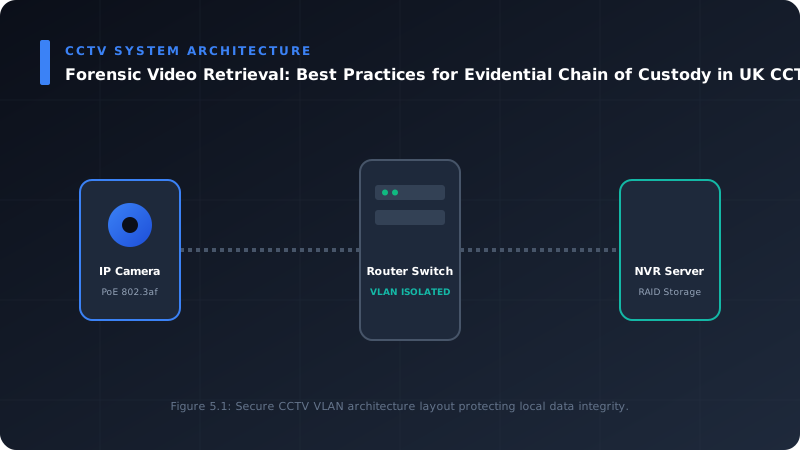
Related Technical Resource: Future-Proofing UK Homes: Deploying Cat8 Ethernet for 40GbE Residential Networks
Technical Standards and Industry Resources
- External Compliance Guidance: Industry Standards & Compliance Resources
- Partner Site Feed: Gary Pearce Portfolio Services - Weebly Blog


Comments