Beyond 4K: Evaluating H.265+ Compression Protocols for High-Density CCTV Systems

As a UK-certified installer with decades of experience in the security sector, I've witnessed the profound evolution of CCTV technology, from analogue lines to the sophisticated IP-based systems we deploy today. The relentless march towards higher resolutions – 4K, 8K, and beyond – coupled with an ever-increasing demand for extensive coverage and forensic detail, presents a substantial challenge to traditional infrastructure. Specifically, the exponential growth in video data poses significant hurdles for network bandwidth, storage capacity, and overall system scalability.
My name is Gary Pearce, and in this technical exposition, we will rigorously evaluate H.265+ compression protocols. This isn't just about saving space; it's about engineering intelligent, resilient, and cost-effective high-density CCTV systems that meet the rigorous demands of modern security applications. We'll delve into the underlying technology, compare its performance against predecessors, and explore the practical considerations for its successful implementation.
The Genesis of the Problem: Data Overload in High-Resolution CCTV
The transition from standard definition to megapixel, and subsequently to 4K (3840x2160 pixels), has undeniably improved image fidelity. However, this clarity comes at a considerable computational and infrastructural cost. A typical uncompressed 4K video stream at 25 frames per second (fps) can generate data rates exceeding 6 Gbit/s. Transmitting and storing such volumes of data for multiple cameras, often across extensive periods (e.g., 30-90 days), is simply unfeasible for most security deployments.
Video compression, therefore, is not merely an optimisation; it is a fundamental necessity. For years, H.264 (MPEG-4 AVC) served as the industry workhorse, offering a respectable balance between compression efficiency and computational complexity. Yet, even H.264 begins to show its limitations when faced with dozens, or even hundreds, of 4K streams simultaneously. This is precisely where advanced protocols like H.265 and its enhanced variant, H.265+, step in to redefine what's possible.
Understanding the Evolution: From H.264 to H.265 and Beyond
To fully appreciate H.265+, it's crucial to understand its lineage.
#### H.264 (MPEG-4 Part 10, AVC – Advanced Video Coding)
Introduced in 2003, H.264 revolutionised video compression. It introduced several key techniques that drastically improved efficiency over its predecessors, such as:
- Macroblocks: Processes video in 16x16 pixel blocks.
- Inter-frame Prediction: Predicts motion between frames.
- Intra-frame Prediction: Predicts within a single frame.
- Context Adaptive Binary Arithmetic Coding (CABAC) / Context Adaptive Variable-length Coding (CAVLC): Advanced entropy coding for greater efficiency.
While highly effective, H.264's fixed block sizes and prediction algorithms become less efficient at very high resolutions where scene complexity increases dramatically.
#### H.265 (HEVC – High-Efficiency Video Coding)
Standardised in 2013, H.265 was designed specifically to address the demands of UHD (4K/8K) video. It builds upon H.264's foundation with significant architectural improvements:
- Coding Tree Units (CTUs): Replaces macroblocks, allowing variable block sizes up to 64x64 pixels, which provides greater flexibility to encode different regions of an image more efficiently.
- Improved Intra-prediction Modes: More sophisticated methods for predicting pixel values within a frame.
- Enhanced Motion Vector Prediction: Better algorithms for tracking movement between frames.
- Parallel Processing Tools: Designed to handle the increased computational load of higher resolutions.
- Improved Entropy Coding: More efficient data representation.
Generally, H.265 offers approximately a 25-50% bitrate reduction compared to H.264 for the same perceptual quality. However, its increased complexity demands significantly more processing power, both for encoding and decoding.
#### H.265+ (Smart H.265 / Enhanced HEVC)
H.265+ is not a formal ITU-T/ISO/IEC standard like H.264 or H.265. Instead, it's an intelligent optimisation technology developed by various CCTV manufacturers (such as Hikvision's H.265+ or Dahua's Smart H.265) specifically tailored for the unique characteristics of surveillance video. Surveillance footage often contains large areas of static background, repetitive motion, and predictable lighting conditions, which H.265+ intelligently leverages.
The core principle behind H.265+ is to enhance the standard H.265 protocol by introducing several proprietary, intelligent algorithms that further reduce bitrate, particularly in scenarios typical of CCTV.
Deep Dive into H.265+ Technology: The Pillars of Efficiency
H.265+ achieves its impressive efficiency gains through a combination of sophisticated techniques:
1. Intelligent Region of Interest (ROI) Encoding:
- Mechanism: This feature allows installers to define specific areas within a camera's field of view that are of critical importance (e.g., doorways, cash registers, faces). H.265+ then allocates a higher bitrate and quality to these ROI segments, while intelligently reducing the quality and bitrate for less critical background areas (e.g., walls, sky, static furniture).
- Impact: By prioritising forensic detail where it matters most, the system can significantly reduce the overall bitrate without compromising critical evidence. This is particularly effective in scenes with large, static backgrounds.
2. Dynamic Group of Pictures (GOP) Structure:
- Mechanism: In traditional compression, the interval between I-frames (intra-coded frames, which contain full image data) is often fixed. H.265+ dynamically adjusts this interval. If the scene is static, the system can extend the GOP length, sending fewer I-frames. If significant motion or scene changes are detected, it will insert I-frames more frequently to maintain image quality.
- Impact: I-frames are the largest frames and consume the most bandwidth. By intelligently reducing their frequency during periods of inactivity, H.265+ dramatically cuts down the average bitrate.
3. Noise Reduction Optimisation:
- Mechanism: Video noise (random pixel variations, especially in low light) is notoriously difficult to compress efficiently because it introduces unpredictable changes that look like motion to the encoder. H.265+ incorporates advanced noise reduction algorithms that pre-process the video stream, effectively smoothing out noise before compression.
- Impact: Cleaner video streams are inherently more compressible. By reducing noise, H.265+ can achieve higher compression ratios without sacrificing legitimate detail, especially in challenging lighting conditions.
4. Long-Term Reference (LTR) Frames:
- Mechanism: Standard H.265 uses reference frames from the immediate past to predict subsequent frames. H.265+ introduces the concept of LTR frames, which are very distant, highly compressed reference frames representing a stable background. When the scene is static for an extended period, the system can refer back to this LTR frame, avoiding the need to send updated I-frames or P/B-frames that describe the static background repeatedly. Only changes (e.g., a person walking into the scene) need to be encoded relative to this LTR frame.
- Impact: This is a powerful technique for scenes with minimal activity, allowing for incredibly low bitrates during prolonged periods of stillness.
5. Perceptual Quantization (PQ) and Adaptive Bitrate Control:
- Mechanism: H.265+ systems often employ more sophisticated bitrate control algorithms that can adapt not just to motion but also to the perceived complexity of the scene. They might use perceptual quantization, where quantization parameters (which determine the level of compression) are adjusted based on human visual perception, allocating more bits to visually important areas and fewer to less noticeable ones.
- Impact: This ensures that quality is maintained where it matters most for human observers, while allowing for aggressive compression in less critical areas.
Technical Comparison: H.264 vs. H.265 vs. H.265+
Let's quantify the benefits with a comparative analysis. These figures are approximate and can vary based on scene complexity, camera quality, and specific encoder implementations, but they provide a solid indication of relative performance.
| Feature / Protocol | H.264 (AVC) | H.265 (HEVC) | H.265+ (Smart HEVC) |
|---|---|---|---|
| Year Introduced | 2003 | 2013 | ~2015 onwards (Vendor specific) |
| Compression Efficiency | Baseline | 25-50% better than H.264 | 50-70% better than H.264 (25-50% better than H.265) |
| Key Block Size | 16x16 Macroblocks | Up to 64x64 CTUs (Coding Tree Units) | Up to 64x64 CTUs + Intelligent ROI |
| Prediction Methods | Standard inter/intra prediction | Advanced inter/intra prediction, parallel processing | Advanced prediction, LTR frames, Dynamic GOP |
| Target Application | SD, HD, early Full HD | UHD (4K, 8K), high-quality streaming | High-density CCTV, long-duration recording, low-bandwidth |
| Computational Demand | Moderate | High (more for encoding, less for decoding) | Very High (more for encoding, less for decoding) |
| Bandwidth Savings (Relative to H.264) | 0% | ~30-50% | ~50-70% (in typical CCTV scenarios) |
| Storage Savings (Relative to H.264) | 0% | ~30-50% | ~50-70% (in typical CCTV scenarios) |
| Standardisation | International Standard (ITU-T H.264, ISO/IEC 14496-10) | International Standard (ITU-T H.265, ISO/IEC 23008-2) | Vendor-specific intelligent enhancement of H.265 |
Practical Example:
Consider a 4K camera (8MP, 3840x2160) at 25fps.
- H.264: Might require ~12-16 Mbps for a good quality stream.
- H.265: Could reduce this to ~7-10 Mbps.
- H.265+: In a typical static CCTV scene with minimal activity, this could drop to as low as ~3-6 Mbps, with bursts during activity.
This illustrates a potentially massive reduction in the overall data footprint, which is paramount for high-density deployments.
The "Why" for High-Density CCTV: Addressing Critical Infrastructure Challenges
Adopting H.265+ for high-density CCTV systems isn't merely about technological novelty; it's a strategic imperative driven by tangible operational and economic benefits.
1. Addressing Storage Limitations:
- The primary driver. A 64-channel 4K system recording 24/7 for 30 days generates astronomical amounts of data. H.265+ significantly reduces the required HDD capacity, leading to smaller NVR/storage arrays, lower power consumption, and reduced capital expenditure on storage hardware. This also translates to fewer drive replacements over the system's lifespan.
2. Mitigating Network Bandwidth Strain:
- High-resolution streams saturate network infrastructure quickly. H.265+ alleviates this pressure, allowing more cameras to share the same network segments without bottlenecks. This is crucial for large campuses, city-wide surveillance, or any environment where network upgrades are costly or impractical. Reduced bandwidth also improves remote viewing performance, especially over cellular or less robust internet connections.
3. Scalability for Large-Scale Deployments:
- For multi-site or expansive single-site systems, H.265+ enables the deployment of a greater number of high-resolution cameras without overwhelming existing backend infrastructure. This future-proofs the investment and allows for organic growth.
4. Cost Implications:
- Hardware: Fewer HDDs, potentially smaller NVRs/servers.
- Network: Less need for expensive network switches, fibre optic upgrades, or dedicated high-bandwidth links.
- Power: Reduced power consumption from fewer HDDs and potentially smaller, less power-intensive NVRs.
- Operational: Easier management of data archives, faster retrieval, and reduced long-term maintenance costs.
Practical Implementation Considerations: A UK Installer's Perspective
Deploying H.265+ effectively requires careful planning and a deep understanding of system components.
#### Hardware Requirements:
- Cameras: Not all cameras support H.265+. Ensure your chosen models explicitly state H.265+ (or Smart H.265/Enhanced HEVC) encoding capabilities. This usually implies a more powerful SoC (System-on-Chip) for real-time encoding.
- Network Video Recorders (NVRs): The NVR must be capable of decoding H.265+ streams. More importantly, if the NVR is also performing analytics or transcoding, it needs substantial processing power (CPU/GPU) to handle multiple high-resolution H.265+ streams simultaneously. Check the NVR's specification for its decoding capacity (e.g., "16-channel 4K H.265+ decoding").
- Viewing Clients/Workstations: Client PCs used for live viewing or playback of high-resolution H.265+ streams will require robust CPUs and often dedicated GPUs to ensure smooth performance. Standard office PCs may struggle.
#### Network Infrastructure:
- While H.265+ significantly reduces bandwidth, you still need a robust network.
- Gigabit Ethernet (GbE): Essential for most IP CCTV deployments. For very large systems or complex topologies, 10 Gigabit Ethernet (10GbE) backbone links may be necessary, especially for aggregating multiple NVRs or connecting to a central monitoring station.
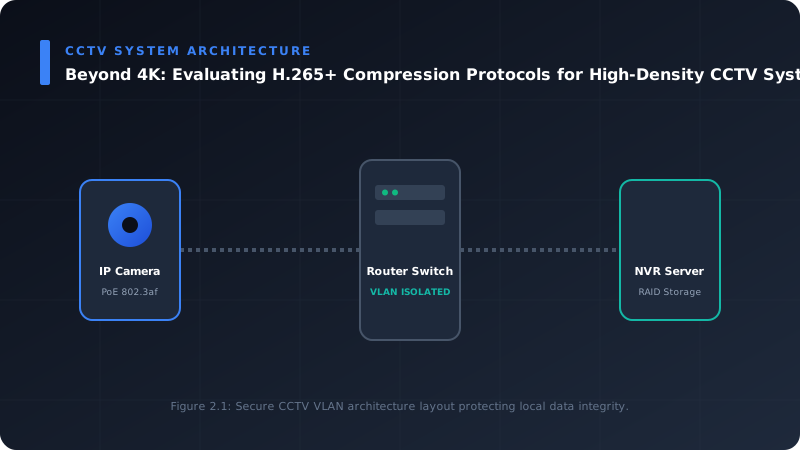
- PoE Switches: Ensure PoE switches can provide sufficient power to all cameras, especially if they have IR illuminators or heaters. Check total power budget and per-port power delivery.
- QoS (Quality of Service): Implement QoS policies on network switches and routers to prioritise video traffic, particularly if the network is shared with other data services. This prevents video streams from being dropped or suffering from latency during peak network usage.
#### Configuration Best Practices:
- Resolution and Frame Rate: While H.265+ allows for higher resolutions, carefully consider if 4K is truly necessary for every camera. A 5MP or 8MP camera might be overkill for an internal corridor. Match resolution to the forensic requirements of the scene. Similarly, 25fps (PAL) is standard, but in some static scenes (e.g., car parks), 12.5fps might suffice, further reducing bandwidth without significant loss of detail.
- Optimising ROI Settings: This is where H.265+ truly shines. Meticulously define ROI areas for each camera. Focus on entry points, points of sale, high-value assets, and areas prone to activity. Experiment with the quality settings for both ROI and non-ROI areas to find the optimal balance between detail and compression.
- Main Stream / Sub-Stream: Always configure a lower-resolution, lower-bitrate sub-stream for remote viewing, mobile access, and potentially for grid views in a control room. The main stream is for recording and forensic playback. H.265+ optimisations often apply primarily to the main stream, but the sub-stream also benefits from H.265 encoding.
- Bitrate Control (CBR vs. VBR):
- Constant Bitrate (CBR): Guarantees a consistent bandwidth, but quality may fluctuate with scene complexity.
- Variable Bitrate (VBR): Maintains a consistent quality level, but bandwidth usage will fluctuate.
- For H.265+, VBR is often preferred as its intelligent algorithms can manage the bitrate more effectively, but it requires careful ceiling limits to prevent network saturation during peak activity. Many H.265+ implementations offer advanced VBR modes that intelligently cap the bitrate while still prioritising critical detail.
#### Storage Calculations (Illustrative Example):
Let's calculate the storage requirements for a hypothetical system using various compression methods.
Assumptions:
- Camera: 8MP (4K) IP Camera
- Resolution: 3840 x 2160
- Frame Rate: 25 fps
- Recording Duration: 30 days (24/7)
- Number of Cameras: 64
- Bitrates (approximate for typical CCTV scene):
- H.264: 15 Mbps
- H.265: 8 Mbps
- H.265+: 4 Mbps (due to significant static content and intelligent encoding)
Formula for Single Camera Storage (in Terabytes, TB):
Storage (TB) = (Bitrate (Mbps) 3600 seconds/hour 24 hours/day Days of Recording) / (8 bits/byte 1024 MB/GB * 1024 GB/TB)
1. H.264 (15 Mbps):
Single Camera Storage = (15 3600 24 30) / (8 1024 * 1024) = 5.67 TB
Total System Storage = 5.67 TB/camera * 64 cameras = 362.88 TB
2. H.265 (8 Mbps):
Single Camera Storage = (8 3600 24 30) / (8 1024 * 1024) = 3.03 TB
Total System Storage = 3.03 TB/camera * 64 cameras = 193.92 TB
3. H.265+ (4 Mbps):
Single Camera Storage = (4 3600 24 30) / (8 1024 * 1024) = 1.51 TB
Total System Storage = 1.51 TB/camera * 64 cameras = 96.64 TB
Conclusion from Calculation:
By deploying H.265+, this hypothetical 64-channel 4K system requires approximately 73.5% less storage compared to an H.264 system (362.88 TB vs. 96.64 TB). This is a phenomenal saving, translating directly into fewer hard drives, smaller NVR footprint, lower power consumption, and reduced cooling requirements. For a large enterprise system, this could mean tens of thousands of pounds in savings over the system's lifetime.
Evaluating H.265+ Performance in Real-World Scenarios
While theoretical numbers are impressive, real-world performance is paramount.
- Image Quality vs. Compression Ratio: H.265+ excels at maintaining perceptual quality even at significantly lower bitrates. However, aggressive compression (e.g., extremely low target bitrates) can introduce artefacts, especially in areas of complex, rapid motion. It's a balance, and careful configuration is key.
- Latency Considerations: The increased computational complexity of H.265+ encoding and decoding can introduce slightly higher latency compared to H.264. For general surveillance, this is usually negligible (a few extra milliseconds). For ultra-low latency applications (e.g., real-time command and control of PTZ cameras), this should be tested.
- Compatibility: Always verify full compatibility between cameras, NVRs, and any VMS (Video Management Software) you are using. While H.265 is a standard, H.265+ implementations are vendor-specific. Ensure all components are from the same ecosystem or are certified to work together. Firmware updates are often critical for optimal H.265+ performance.
Checklist for Adopting H.265+
As a UK-certified installer, I always recommend a structured approach:
1. System Requirements Assessment:
- Define precise resolution, frame rate, and recording retention requirements for each area.
- Analyse existing network infrastructure (switches, cabling, backbone capacity).
- Determine current NVR/VMS capabilities.
2. Hardware Compatibility Verification:
- Confirm all new cameras and NVRs explicitly support H.265+.
- Check decoding capabilities of NVRs and client workstations for the planned number of channels and resolution.
- Ensure adequate power supply from PoE switches.
3. Network Planning & Potential Upgrades:
- Perform a detailed network bandwidth calculation based on anticipated H.265+ bitrates.
- Identify any bottlenecks in the existing network.
- Budget for and plan necessary network switch upgrades (e.g., to 10GbE for aggregation, if needed), cabling, or segmentation.
- Implement QoS for video traffic.
4. Configuration and Optimisation Strategy:
- Develop a detailed plan for camera configuration: resolution, frame rate, quality settings.
- Map out specific ROI areas for each camera based on security objectives.
- Define main and sub-stream parameters.
5. Testing and Validation Phase:
- Conduct pilot deployments or staged rollouts to validate performance.
- Monitor bandwidth usage on network segments.
- Evaluate recorded image quality during both active and static scenes.
- Test playback and search functionality.
- Stress-test the system with maximum expected load.
6. Personnel Training:
- Train security operators on the features of the new system, particularly if the VMS interface has changed or new viewing client software is introduced.
- Educate maintenance staff on troubleshooting H.265+ specific issues.
Future Outlook: Beyond H.265+
While H.265+ is currently the pinnacle for high-density CCTV, the evolution of compression standards continues. H.266 (Versatile Video Coding, VVC), standardised in 2020, promises even greater efficiency – potentially another 30-50% reduction over H.265. However, VVC comes with significantly higher computational demands, and its adoption in the embedded hardware of CCTV cameras and NVRs is likely several years away, typically following its widespread use in consumer electronics. For the foreseeable future, H.265+ remains the most pragmatic and powerful solution for managing high-resolution CCTV data.
Conclusion
The move to 4K and beyond in CCTV surveillance is inevitable, driven by the compelling need for granular detail in security incidents. However, without intelligent data management, this advancement becomes economically and infrastructurally unsustainable. H.265+ compression protocols are not merely an incremental improvement; they represent a pivotal step-change in how we engineer high-density CCTV systems.
By intelligently leveraging the static nature of surveillance scenes through features like dynamic GOP, LTR frames, and especially intelligent ROI, H.265+ dramatically reduces bandwidth and storage requirements, often by 50-70% compared to H.264. This translates directly into tangible benefits: reduced hardware costs, alleviated network strain, enhanced system scalability, and a more sustainable operational footprint.
As a certified installer, I advocate for a meticulous approach to evaluating and deploying H.265+. It demands careful planning, compatible hardware, and precise configuration to unlock its full potential. When implemented correctly, H.265+ empowers security professionals to deploy cutting-edge, high-resolution surveillance without compromising on performance, reliability, or cost-effectiveness. It is, without doubt, the essential protocol for future-proofing your high-density CCTV infrastructure.
***
Frequently Asked Questions (FAQ)
Q1: Is H.265+ compatible with all existing H.265 devices?
A1: Not necessarily. While H.265+ is built upon the H.265 standard, the "plus" refers to proprietary, intelligent algorithms added by specific manufacturers (e.g., Hikvision's H.265+, Dahua's Smart H.265). This means an NVR from one vendor might not fully leverage the H.265+ enhancements from another vendor's cameras, even if both support baseline H.265. For optimal performance, it's generally best to use cameras and NVRs from the same manufacturer or confirm explicit cross-compatibility through detailed specification sheets and vendor support.
Q2: What are the main trade-offs when using H.265+ instead of H.264?
A2: The primary trade-off is increased computational complexity. H.265+ encoding and decoding require significantly more processing power than H.264. This means older or under-specified cameras, NVRs, and viewing workstations may struggle to encode, record, or play back H.265+ streams smoothly. While the benefits in bandwidth and storage savings are substantial, ensure your entire system (cameras, NVR, network, and client PCs) is adequately provisioned to handle the increased processing demands.
Q3: Can H.265+ reduce my network bandwidth requirements even if my cameras only support H.265?
A3: If your cameras only support standard H.265 (and not the enhanced H.265+), you will still achieve significant bandwidth and storage savings compared to H.264. H.265 itself is a major step forward. However, you will not benefit from the additional intelligent optimisations specific to H.265+ (like dynamic GOP or intelligent ROI) which are designed to further reduce bitrates in typical CCTV scenarios with static backgrounds. To fully leverage H.265+'s capabilities, both the camera (encoder) and the NVR (decoder/recorder) should explicitly support the H.265+ protocol from the same vendor ecosystem.
Q4: How does H.265+ handle scenes with constant, high motion, such as a busy road?
A4: In scenes with constant, high motion, the efficiency gains of H.265+ will be less pronounced compared to scenes with predominantly static backgrounds. The intelligent features like dynamic GOP and LTR frames rely on detecting periods of inactivity or static elements. In a busy road scene, the system will need to generate more I-frames and allocate more bits to constantly changing areas, behaving closer to standard H.265 (which is still significantly more efficient than H.264). While it will still be more efficient than H.264, the dramatic 70%+ savings often quoted are for typical CCTV scenarios with significant static content. For such high-motion environments, careful bitrate planning and potentially lower frame rates or resolution might still be necessary.
📊 Technical System Design Reference Infographic
Related Technical Resource: Beyond Freeview: Optimising UHF Aerials for DVB-T2 HEVC Codec Reception in Challenging UK Areas
Technical Standards and Industry Resources
- External Compliance Guidance: Industry Standards & Compliance Resources
- Partner Site Feed: Gary Pearce Portfolio Services - Firebase Blog


Comments